
Why Marketers Still Debate the SEO Priority
The foundation of every successful digital marketing strategy is Search Engine Optimization (SEO). Yet, a perennial question plagues every marketing team: Should we spend more time perfecting our internal website structure (On-Page) or building external credibility (Off-Page)?
The problem many businesses face is a fragmented strategy. They might chase backlinks without addressing slow site speed, or meticulously optimize titles while ignoring social signals. This leads to wasted resources and stagnation in search rankings. To achieve dominance in the SERPs (Search Engine Results Pages), you need to understand that this isn’t an “either/or” question—it’s a matter of balance and synergy.
This comprehensive guide defines both disciplines, outlines their critical components, and, most importantly, reveals how to prioritize your efforts for maximum ranking impact.
Featured Snippet Definition: The Two Pillars of SEO
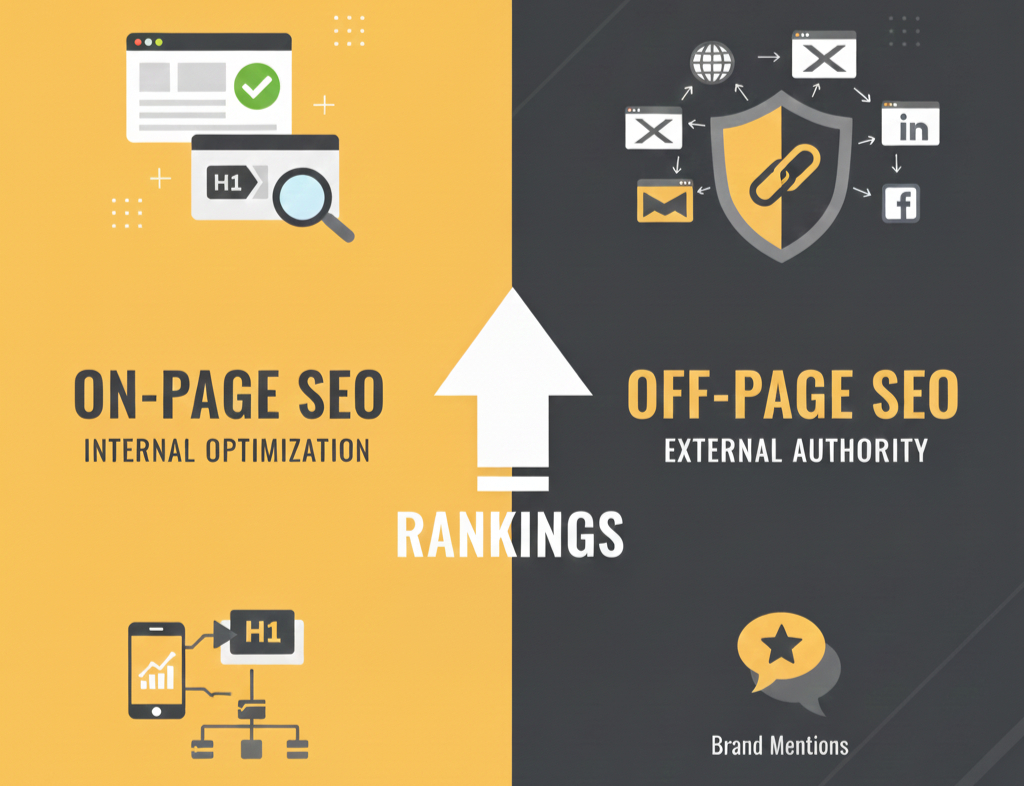
SEO is broadly categorized into two main groups, which together determine a website’s overall ranking performance:
- On-Page SEO: This refers to all optimization factors controlled directly on your website to improve organic visibility. This includes content quality, title tags, site speed, and technical code.
- Off-Page SEO: This refers to actions taken outside of your website to impact rankings. This primarily involves link building (getting backlinks from other authoritative sites), social media marketing, and brand mentions.
How to Master the Components of Each SEO Pillar
To rank competitively, you must execute both strategies flawlessly. Here is a breakdown of the core tasks for each.
1. Mastering On-Page SEO: Building a Great House
On-Page SEO focuses on making your content and website structure clear and enjoyable for both users and search engine crawlers. This provides the relevance signal to Google.
| Core Task | Description | Ranking Impact |
| Content Quality | Creating unique, comprehensive, and high E-E-A-T (Experience, Expertise, Authoritativeness, Trustworthiness) content. | High. This is the core of user value. |
| Technical SEO | Optimizing site speed (Core Web Vitals), mobile-friendliness, and crawlability (robots.txt, XML sitemaps). | High. Essential for indexation and user experience. |
| Keyword Optimization | Strategic placement of primary and LSI keywords in Title Tags, Meta Descriptions, and H1/H2 Headings. | Moderate to High. Helps define page topic. |
| Internal Linking | Connecting relevant pages within your own site to distribute link equity (PageRank). | Moderate. Boosts deep pages and dwell time. |
Actionable Step: Begin every SEO campaign with a comprehensive On-Page audit. Without a fast, accessible, and high-quality “house,” no amount of external linking can truly fix your ranking problems.
2. Mastering Off-Page SEO: Building External Authority
Off-Page SEO is the process of building your site’s authority and trust signals across the web. This tells Google that other people consider your site a credible source.
- Link Building (Backlinks): This is the single most important component of Off-Page SEO. High-quality backlinks from authoritative and relevant websites act as “votes of confidence,” transferring credibility to your domain.
- Brand Mentions: Unlinked mentions of your brand or company name on other websites, forums, and publications also signal relevance and popularity to search engines.
- Social Signals: Shares, likes, and comments on platforms like LinkedIn, Facebook, and X (formerly Twitter) don’t directly boost rankings, but they contribute to increased visibility and traffic, leading to natural backlinks.
Actionable Step: Focus on link quality over quantity. A single editorial backlink from a highly authoritative site is worth hundreds of directory or low-quality links. Use outreach to earn links from sites relevant to your niche.
We Recommend: The Synergy Strategy
At Digitreams, we often get asked, “Which one matters most?”
In our experience, On-Page SEO provides the foundation, and Off-Page SEO provides the power.
- On-Page is Priority One (The Gatekeeper): Without excellent On-Page SEO, your site won’t be indexed properly, and your content won’t be seen as relevant. You must fix site speed, mobile issues, and content quality first.
- Off-Page Determines Your Ceiling: Once your foundation is solid, Off-Page SEO (primarily high-quality link building) is what takes you from the bottom of Page 1 to the coveted top 3 spots. It’s the decisive factor in highly competitive niches.
What we have found is that a 60/40 split—60% effort on content and technical excellence (On-Page), and 40% on building external authority (Off-Page)—offers the most sustainable ROI.
Conclusion
The debate is over: On-Page and Off-Page SEO are two sides of the same coin. On-Page makes your site relevant, while Off-Page makes it authoritative. Prioritize building a solid, fast, and high-quality website first, and then aggressively pursue high-authority backlinks to boost your site’s trust score and secure those top rankings.
Frequently Asked Questions (FAQs)
Q: Which SEO factor is generally considered the strongest ranking signal?
A: High-quality backlinks (Off-Page SEO) and Content Quality (On-Page SEO) are widely considered the two strongest ranking signals by industry experts.
Q: Can I rank highly with only great On-Page SEO?
A: In low-competition niches, yes. In high-competition niches, no. You need the authority provided by Off-Page SEO to compete with established domains.
Q: What is the most critical technical SEO factor?
A: As of 2026, Core Web Vitals (measuring site speed, interactivity, and visual stability) is the most critical technical factor as it directly impacts user experience.
Q: Is guest posting still a good Off-Page tactic?
A: Yes, provided the host site is high-quality, relevant to your niche, and the content is genuinely useful. Guest posting should be used for relationship building and genuine link earning, not spammy link volume.